The EPA contributes to OECD webinar on supporting veterans’ mental health in Ukraine
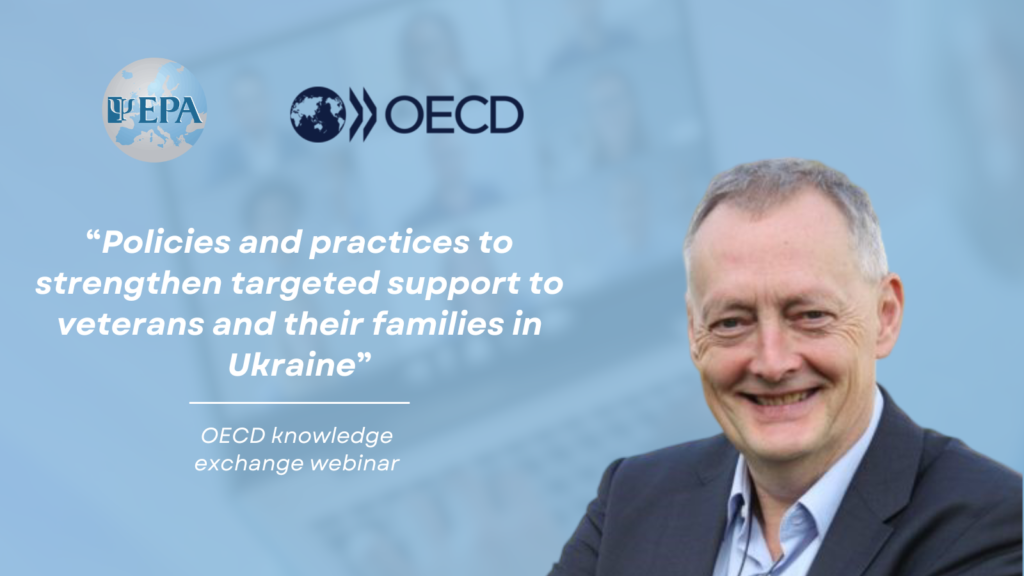
On 17 December 2025, EPA Past-President Prof. Geert Dom took part in an OECD knowledge exchange webinar titled “Policies and practices to strengthen targeted support to veterans and their families in Ukraine.” The webinar brought together international and Ukrainian experts to discuss how social and health systems can respond to the unprecedented needs arising from the conflict in Ukraine.
The webinar focused on the challenge of providing targeted, integrated, support to veterans and their families, an issue of historic scale in Europe. Participants shared policy experiences from Australia, Canada, France, Ukraine and the United Kingdom, with particular attention to early identification of needs, integrated service delivery, and mental health support.
In his intervention, Prof. Dom expressed his appreciation for the unprecedented efforts undertaken by Ukraine, notably the strong focus on alcohol-related issues within veteran support policies. Speaking from the perspective of an international scientific association, Prof. Dom emphasised that veterans’ mental health must be embedded within broader mental health system reforms, closely linked to somatic care and community-based services. He also referred to the conclusions of the the Lancet Psychiatry Commission on mental health in Ukraine, led by Prof. Irina Pinchuk.
Prof. Dom highlighted the role international scientific associations can play by sharing evidence-based practices, offering training resources, and supporting professionals working on complex conditions such as PTSD. He also drew attention to the EPA Guidance Paper on Digitalising Mental Health Care, published in European Psychiatry, and freely available online, noting that Ukraine’s rapid adoption of digital mental health tools offers valuable lessons for the international community.
A key takeaway from Prof. Dom’s intervention was the importance of implementation: developing effective and practical ways to apply existing knowledge remains one of the main challenges in delivering high-quality psychiatric care, particularly in crisis and post-conflict settings.