
Stress Management within Higher Emotional Labor Demands – Resilience and Peer Support
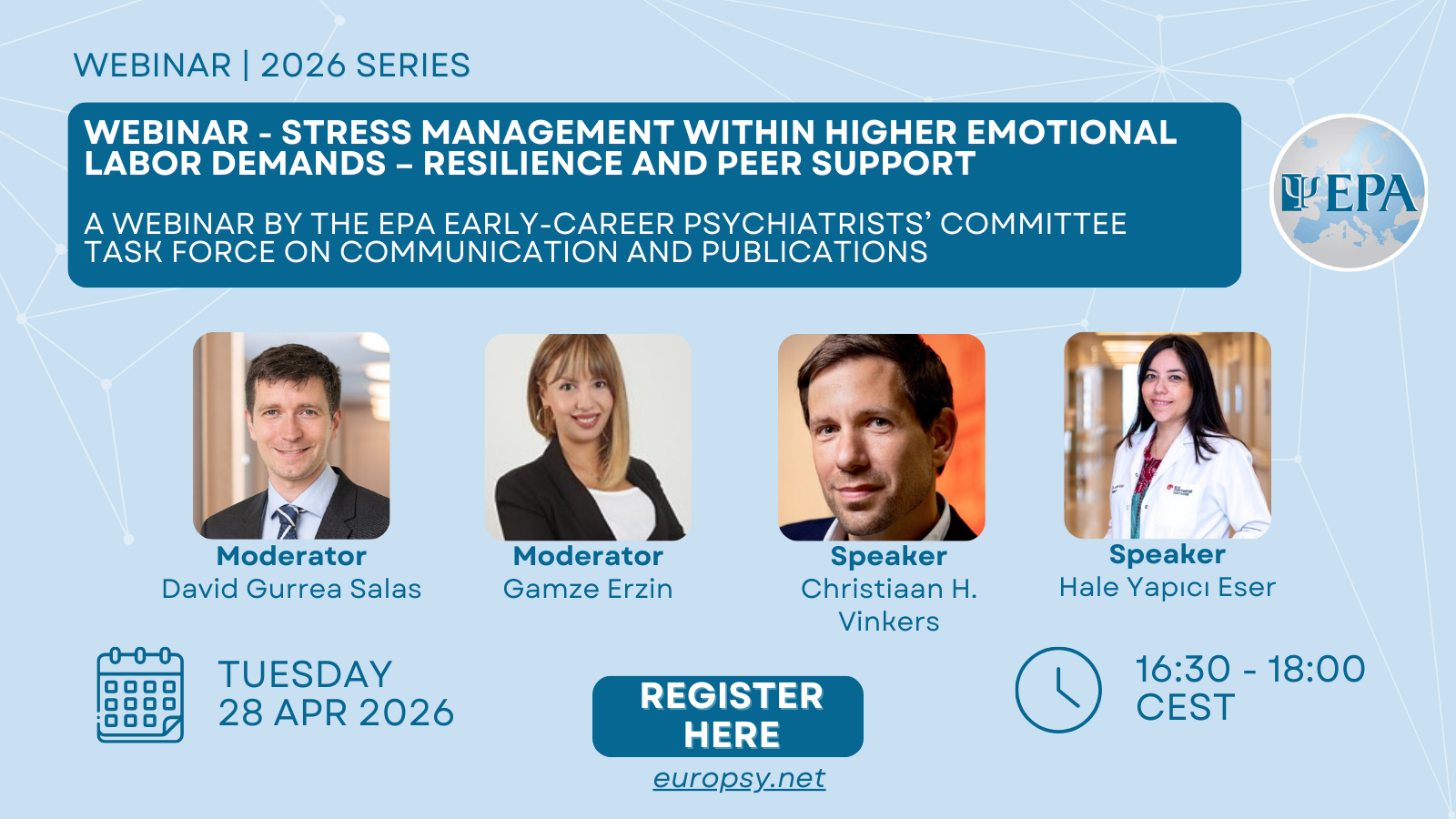
For World Day for Safety & Health at Work, the EPA is pleased to announce the webinar “Stress Management within Higher Emotional Labor Demands – Resilience and Peer Support,” taking place on Tuesday, 28 April 2026, from 16:30 to 18:00 CEST. This webinar is organised by the Early Career Psychiatrists’ Committee – Task Force on Communication and Publications.
Details:
- Title: Stress Management within Higher Emotional Labor Demands – Resilience and Peer Support
- Date: Tuesday 28 April 2026
- Time: 16:30 – 18:00 CEST
- Platform: Zoom
- Registrations: Open
Key learning objectives:
- Identify key neuroscientific stress pathways (LC-NE, HPA) and their roles in appraisal, regulation, and maladaptation.
- Interpret common stress biomarkers (cortisol, inflammatory markers) and explain how resilience moderates their associations.
- Apply a multilevel, time-dynamic framework to differentiate resilience trajectories, including post-traumatic growth/emergent functioning.
- Outline therapeutic companionship strategies (psychoeducation, support scaffolding, peer-to-peer respite) that promote flexible coping and reduce caregiver burden.
Programme
16:30 – 16:45 | Gamze Erzin& David Gurrea Salas – Welcome, context and speakers’ introduction
16:45 – 17:10 | Christiaan H. Vinkers – Stress and resilience: from neurobiology to daily life
17:10 – 17:35 | Hale Yapıcı Eser – Navigating Social Role Stressors and Life Transitions: Resilience and Peer Support in High Emotional Labor Environments
17:35 – 17:50 | Q&A Session
17:50 – 18:00 | Gamze Erzin & David Gurrea Salas – Conclusions
Abstract
This webinar integrates cutting-edge evidence on how stress is generated, regulated, and therapeutically modulated across neurobiological and psychosocial levels, and how these processes foster resilient outcomes. We begin with a concise tour of core pathways—the locus-coeruleus–noradrenergic system and the HPA axis—showing how stressor detection, appraisal, and amygdala–prefrontal circuitry shape attention, memory, and coping, and when these dynamics become maladaptive under chronic load, highlighting that resilience can buffer stress biology and that current evidence is more consistent for inflammation than for cortisol.
Building on a heuristic multilevel dynamic framework, we situate resilience after adversity across contexts (individual, family, community, socio-cultural), functional levels (from inflammatory and endocrine to cognitive/behavioral and well-being), and over time. This clarifies trajectories such as stable functioning, “bouncing back,” and emergent functioning—a rise beyond pre-adversity levels, aligning with post-traumatic growth. Translationally, we examine caregiver stress as a real-world case: how burden, support, and technology affinity drive engagement with peer-to-peer respite solutions, pointing to scalable, community-anchored mechanisms to reduce load and enable resilient adaptation.
Participants will leave with a practical map that connects neural circuits, biomarkers, contextual factors, and time-sensitive trajectories to everyday clinical decisions—linking “therapeutical companionship” to flexible coping and growth-oriented outcomes across the lifespan.
Target audience
Early-Career Psychiatrists, psychiatrists, clinical psychologists, and psychological practitioners.
Moderators
- Dr. David Gurrea Salas, Department of Addictive Disorders, Psychiatric Services Aargau, Brugg, Switzerland – Biography
- Dr Gamze Erzin, Private, The Netherlands – Biography
Speakers
- Prof. Christiaan H. Vinkers – Department of Psychiatry, Amsterdam University Medical Center, location Vrije Universiteit Amsterdam, Amsterdam, the Netherlands; Mood, Anxiety, Psychosis, Sleep & Stress program – Biography
- Assoc. Prof. Hale Yapıcı Eser – Koç University School of Medicine, Istanbul, Türkiye – Biography
Additional resources
- Palamarchuk IS, Vaillancourt T. Mental Resilience and Coping With Stress: A Comprehensive, Multi-level Model of Cognitive Processing, Decision Making, and Behavior. Front Behav Neurosci. 2021 Aug 6;15:719674. doi: 10.3389/fnbeh.2021.719674.
- Ringgold V, Rohleder N. Stress and resilience: Associations of stress biomarkers with different conceptualizations of resilience. Curr Opin Behav Sci. 2025;61:101463. doi:10.1016/j.cobeha.2024.101463.