
Use and Abuse of Artificial Intelligence-driven Technologies: Opportunities, Risks, and Ethical Dilemmas for Psychiatry
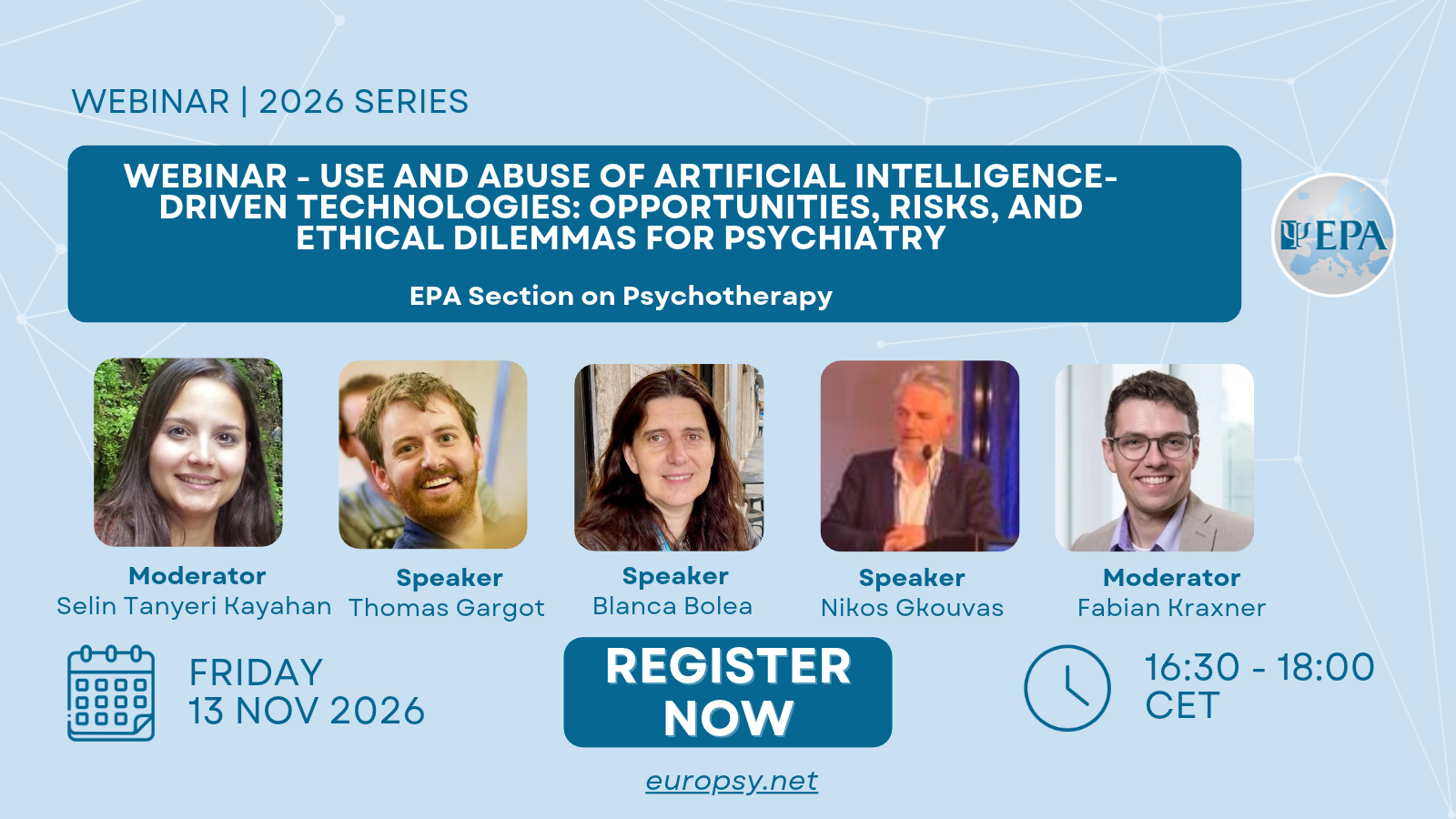
A webinar by the EPA Section on Psychotherapy
The EPA is pleased to announce the webinar “Use and Abuse of Artificial Intelligence-Driven Technologies: Opportunities, Risks, and Ethical Dilemmas for Psychiatry,” which will take place on Friday, 13 November 2026, from 16:30 to 18:00 CET. This webinar is organised by the EPA Section on Psychotherapy.
DETAILS
Title: Use and Abuse of Artificial Intelligence-driven Technologies: Opportunities, Risks, and Ethical Dilemmas for Psychiatry
Date: Friday 13 November 2026
Time: 16:30 – 18:00 CET
Platform: Zoom
Registrations: Open
KEY LEARNING OBJECTIVES
The aim of this webinar is to equip psychiatrists and mental health professionals with a clear understanding of the promises and perils of AI-driven technologies in psychiatric practice.
Participants will:
- Gain insight into the scientific basis and current applications of AI in psychiatry.
- Learn to critically appraise the ethical, clinical, and societal risks of AI misuse.
- Acquire practical strategies for responsibly integrating AI tools while maintaining professional and ethical standards.
PROGRAMME
16:30 – 16:40 | Dr. Fabian Kraxner & Dr. Selin Tanyeri Kayahan – Welcome, context and speakers’ introduction
16:45 – 16:55 | Dr. Thomas Gargot – Psychotherapy in Digital Settings
16:55 – 17:10 | Dr. Blanca Bolea – There’s an App for That-but Should We Prescribe It?
17:10 – 17:25 | Dr. Nikos Gkouvas – AI in Psychopharmacology: Gains and Losses
17:25 – 17:50 | Q&A Session
17:50 – 18:00 | Dr. Fabian Kraxner & Dr. Selin Tanyeri Kayahan – Wrap-up and conclusions
ABSTRACT
Artificial Intelligence (AI) is rapidly transforming mental health care. From diagnostic algorithms and clinical decision-support tools to predictive analytics and conversational agents in patient care, AI-driven technologies promise to reshape psychiatry. Yet, alongside these opportunities come serious challenges: biases in datasets, confirming patients in dangerous cognitive traps, ethical dilemmas in patient autonomy, confidentiality risks, over-reliance on “black box” technologies, and uncertainty about how simulated empathy may affect the therapeutic relationship.
This webinar will explore both the use and abuse of AI in psychiatry. It will provide participants with a balanced, evidence-based perspective on how AI can support clinicians, while also highlighting potential pitfalls and misuse scenarios. Drawing on international expertise in psychiatry, ethics, and digital health, the session will critically analyse real-world examples, offer practical guidance, and open the floor for reflection and debate.
By engaging psychiatrists at all career stages, this webinar seeks to empower the European Psychiatric Association community with the knowledge to evaluate AI-driven technologies thoughtfully, use them responsibly, and safeguard the centrality of the therapeutic relationship.
TARGET AUDIENCE
Psychiatrists (senior and early-career), psychologists and other mental health professionals, medical educators and researchers, policymakers and stakeholders interested in digital health in psychiatry.
MODERATORS
- Dr. Fabian Kraxner, Psychiatrist and Psychotherapist, Councillor Member of the EPA Psychotherapy Section, Medical Director of Mental Health Company, Hedingen, Switzerland – Biography
- Dr. Selin Tanyeri Kayahan, Psychiatrist and Psychotherapist, Secretary of the EPA Psychotherapy Section, Member of EPA Early Career Psychiatrists Committee Task Force on Communication and Publications, Yalvac State Hospital, Isparta, Türkiye – Biography
SPEAKERS
- Dr. Thomas Gargot, Associate Prof in Child and Adolescent Psychiatry, University Hospital Tours, researcher Université de Tours, INSERM, Imaging Brain & Neuropsychiatry iBraiN U1253, 37032, Tours, France, Chair of EPA Psychotherapy Section, Councillor of EPA Digital Psychiatry Section, Tours, France – Biography
- Dr. Blanca Bolea, Psychiatrist, Director of the SCOPE Mental Health Program, Women’s College Hospital, Associate Professor at the University of Toronto, Toronto, Canada. – Biography
- Dr. Nikos Gkouvas, Psychiatrist, Head of AI Digital Mental Health Section, World Psychiatric Association; Board member and President of Informatics and Innovative Technologies, Hellenic Psychiatric Association; Scientific Director, ERMIS Association for Persons with Disabilities, Athens, Greece – Biography
Additional resources
- Berger, T. (2025). Rethinking the therapeutic alliance in digital mental health interventions. World Psychiatry, 24(3), 345–346.
Link: https://doi.org/10.1002/wps.21343 - Cruz-Gonzalez, P., He, A. W., Lam, E. P., Ng, I. M. C., Li, M. W., Hou, R., Chan, J. N., Sahni, Y., Vinas Guasch, N., Miller, T., Lau, B. W., & Sánchez Vidaña, D. I. (2025). Artificial intelligence in mental health care: a systematic review of diagnosis, monitoring, and intervention applications. Psychological medicine, 55, e18.
Link: https://doi.org/10.1017/S0033291724003295 - Rony, M. K. K., Das, D. C., Khatun, M. T., Ferdousi, S., Akter, M. R., Khatun, M. A., Begum, M. H., Khalil, M. I., Parvin, M. R., Alrazeeni, D. M., & Akter, F. (2025). Artificial intelligence in psychiatry: A systematic review and meta-analysis of diagnostic and therapeutic efficacy. Digital health, 11, 20552076251330528.
Link: https://doi.org/10.1177/20552076251330528 - Nazer LH, Zatarah R, Waldrip S, Ke JXC, Moukheiber M, Khanna AK, et al. (2023) Bias in artificial intelligence algorithms and recommendations for mitigation. PLOS Digit Health 2(6): e0000278.
Link: https://doi.org/10.1371/journal.pdig.0000278 - ‘There are no guardrails.’ This mom believes an AI chatbot is responsible for her son’s suicide, Clare Duffy, CNN.
Link: https://edition.cnn.com/2024/10/30/tech/teen-suicide-character-ai-lawsuit